
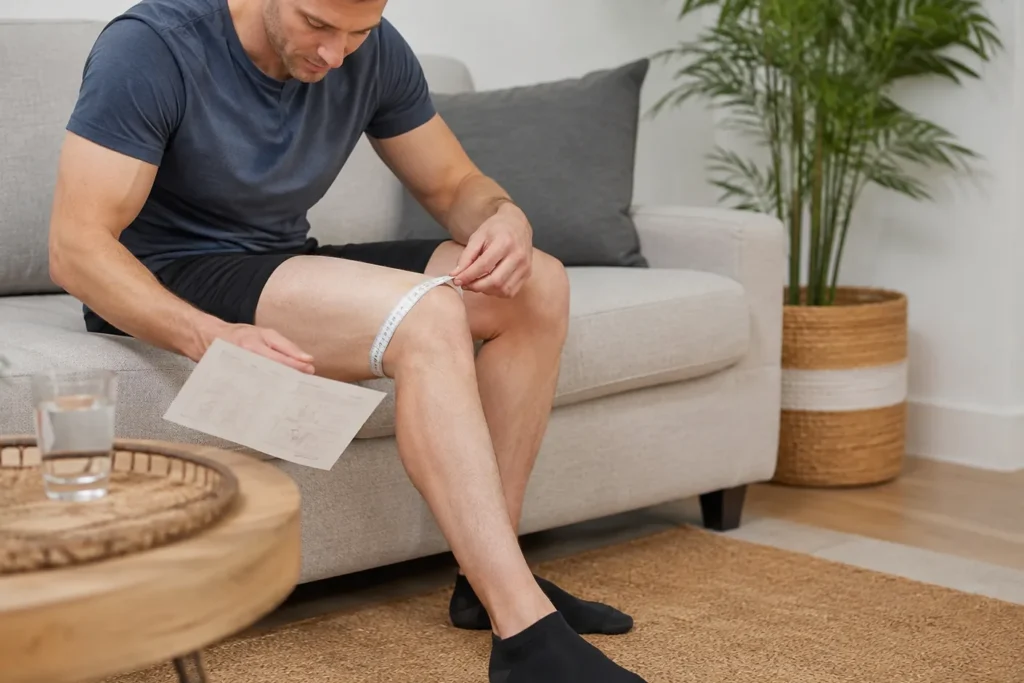
A knee brace that is the wrong size can slip, roll, dig in, or end up back in the return box. The difficult part is that there is no single place to measure for every product.
One manufacturer may ask for the circumference above your kneecap. Another may ask for measurements above and below it. A graduated compression garment may require several circumferences plus leg length.
The safest rule is simple: find the size chart for your exact model before measuring anything.
This is not medical advice. This guide explains how to follow a manufacturer’s sizing chart. It does not determine which brace, sleeve, support level, or compression pressure is appropriate for you. Ask your clinician, fitter, or supplier about those decisions.
First, identify what you are buying
The word “sleeve” is used for two different kinds of product:
- A knitted knee support or soft brace, usually sized by one or two circumferences near the knee
- A graduated medical compression garment, sized using several limb measurements and a separate pressure specification
Do not use the chart for one type to size the other. Confirm the exact brand, model, variant, and side before you begin.
The rule that prevents most mistakes
Use the instructions packaged with the exact product whenever they are available. If you are shopping online, use the manufacturer’s page or official size-chart library for that model.
A general retailer chart is less useful when it is not clearly tied to the same model and variant. Charts can differ even within one brand, particularly when a product has standard, wide, comfort, left, or right versions.
Record where the chart came from and the date you checked it. Product pages can change.
Step 1: Read the entire chart first
Before picking up the tape measure, look for six details:
- The exact landmark. Does the chart mean the center of the kneecap, above it, below it, around the calf, or somewhere else?
- The stated distance. If it says to measure a certain distance from the kneecap, use that distance for that product only.
- The limb position. Straight or bent, standing or seated, relaxed or supported.
- Skin or clothing. Follow the chart’s instruction.
- Units. Check inches versus centimeters before comparing your number with the table.
- Number of measurements. Some products use one. Others use two or more together.
Also check whether the model is side-specific and whether the chart publishes a rule for people who fall between sizes.
Step 2: Take the measurement carefully
Use a flexible measuring tape that lies flat around the leg.
- Measure at the exact landmark stated by the chart.
- Keep the tape level rather than letting it climb or dip behind the leg.
- Let it touch the skin without pulling it tight or leaving it loose.
- Use the body position specified by the manufacturer.
- Take the reading twice.
- Write down both the number and the units.
If the readings differ, repeat the measurement slowly. Do not average numbers taken at different landmarks or in different positions.
If another person is helping, read the chart together first. A perfectly accurate measurement at the wrong location is still the wrong measurement.
Why charts disagree
The manufacturer charts reviewed for this article use different systems.
Bauerfeind’s GenuTrain instructions use measurements above and below the knee at product-specific distances. medi’s genumedi chart uses its own thigh and lower-leg landmarks. Breg publishes a knee support chart based on a single stated measurement, while its custom-brace order form uses a more detailed clinician-facing system.
Those differences are the reason this guide does not publish one universal diagram or measurement point. The correct location is the one printed for your exact product.
If you do not have a flexible tape
Bauerfeind publishes a substitute method for its products using a suitable household item wrapped around the specified location, marked where the ends meet, then laid flat against a ruler or known length.
Treat that as one manufacturer’s method, not a universal workaround. If your product’s manufacturer does not publish an alternative, waiting for a flexible measuring tape is more reliable than improvising with a stretchy or bulky object.
Graduated compression garments need more information
Graduated medical compression is specified by both size and pressure. The pressure is commonly expressed in mmHg and is not the same thing as the garment size.
The medi chart reviewed for this article uses several circumferences at named points along the leg plus a leg-length measurement. The manufacturer also points readers toward proper fitting and repeat measurement when limb circumference changes.
If you are buying a graduated compression garment, use the exact chart and work with the clinician or fitter who specified the pressure. This guide cannot tell you which compression level is suitable.
What to do if you are between sizes
First, look for a between-sizes instruction on the chart. If one exists, follow it for that model.
If the chart is silent, ask the manufacturer, supplier, fitter, or clinician. Do not borrow a rule from another brand or assume that tighter means more supportive. None of the four charts reviewed for this article published a general between-sizes rule.
Use the same approach when:
- Your number falls exactly on a boundary
- Your two legs measure differently
- The measurement changes between attempts or days
- You cannot tell which variant or chart applies
- The product is listed as left- or right-specific
Record the question and the answer you receive. That will help with a return, exchange, or later reorder.
When the product arrives
Check the label on the product or box against the model, side, variant, and size you intended to buy. Then re-read the packaged fitting instructions.
If the brace slips, rotates, rolls, or digs in, check the measurement and chart again. Contact the supplier, fitter, or clinician who recommended or fitted it rather than changing a professionally configured device yourself.
Physical symptoms are different from visible fit behavior. Read the warnings supplied with your own product. Breg’s instructions for one knee support say:
“If you experience, or have an increase in pain, swelling, skin irritation, or any adverse reactions while using this product, immediately consult your medical professional.”
That wording belongs to Breg’s product. Follow the manual supplied with yours and contact a medical professional about symptoms.
Keep a measurement record
Product and chart
- Brand, model, and variant: ______
- Left, right, or either: ______
- Chart source: ______
- Date chart was checked: ______
- Between-sizes rule, if published: ______
Measurements requested by the chart
Use the manufacturer’s own name for each measurement.
| Measurement | Exact location | Position | Units | First reading | Second reading |
|---|---|---|---|---|---|
Result
- Date and time measured: ______
- Size indicated by the chart: ______
- If between sizes, who was asked and what they said: ______
- For graduated compression, pressure specification and who provided it: ______
What this guide does not decide
This guide does not choose a brace, support level, hinge, stay, compression pressure, or treatment. It does not tell you whether you should wear a product or interpret what a symptom means.
Its purpose is narrower: help you locate the correct chart, take the measurements that chart requests, and keep a useful record.
Nothing here confirms that a product is FSA- or HSA-eligible. Eligibility must be checked separately for the exact item and your account or plan.
Frequently asked questions
Where exactly should I place the tape?
At the location stated by the chart for your exact model. The manufacturer examples reviewed for this article use different points, so there is no universal distance above or below the kneecap.
Should my knee be straight or bent?
Follow the chart. Bauerfeind specifies a relaxed, slightly bent position for one product, but another model may give different instructions.
Should I measure over clothing?
Follow your product’s instructions. Bauerfeind tells readers to measure directly on skin for the product material reviewed here, but that does not establish a rule for every brace.
Which leg should I measure?
Measure the leg the product is intended for. If the legs differ and the chart does not address it, ask the supplier, fitter, or clinician.
Why do brands request different measurements?
Their products and sizing systems differ. The documents reviewed here do not explain every design decision, but they clearly show that the measurement schemes are not interchangeable.
My brace slips or feels too tight. Is the size wrong?
Possibly, but a chart alone cannot settle it. Recheck the model and measurement, read the supplied instructions, and contact the supplier, fitter, or clinician. Speak with a medical professional about pain, swelling, skin irritation, or another physical reaction.
Methodology
This article is research-based. It was compiled from published manufacturer material read on the date below: two Bauerfeind USA pages, four medi USA pages including two product size charts, and three Breg, Inc. documents including two PDFs downloaded and read in full. Every measurement point, condition and quotation is attributed in the sentence that carries it, to the specific manufacturer and product it came from. No retailer-authored sizing content was used as a source.
Byline: Kade Lato. Kade Lato is the founder’s editorial pen name. No clinical, tax, or benefits-administration credential is claimed.
PainRecoveryPro has not measured any person, handled, worn, fitted or tested any brace, sleeve or garment, and holds no orthotic, fitting or clinical credential. Nothing here rests on personal experience, and nothing has been reviewed by a clinician or a fitter. Manufacturer material is commercial material; it is cited here as specification and instruction, never as endorsement, and manufacturer claims about what a product does are deliberately not repeated.
The structure is this article’s own non-clinical synthesis rather than any source’s: the two-kinds-of-sleeve split, the source hierarchy, the six things to read off a chart, the side-by-side comparison of what different charts ask for, the described-not-reproduced chart read-through, and the blank measurement record. No source’s size table is reproduced and no source’s diagram is recreated.
This article carries no affiliate links, tracking parameters or referral codes, and names no price or merchant. Brands appear only as the authors of the measurement instructions being cited. See also Editorial Standards and the Medical Disclaimer.
Sources and dates
Every source below was opened and read on September 1, 2026.
| Source | Issuer | Role here |
|---|---|---|
| How to Measure for Bauerfeind Products Without a Measuring Tape | Bauerfeind USA (manufacturer) | The no-tape method and its reference lengths; the measuring conditions; the two instructions that carry this page’s central rule |
| GenuTrain knee brace product page, and its “find your size” panel | Bauerfeind USA (manufacturer) | One product’s stated measurement points and limb condition; a size run with lettered variants; a chart living behind a control rather than in the page text |
| genumedi Knee Support Sizing Chart | medi USA (manufacturer) | A second knee-support measurement scheme, including the medial-side condition, and a standard-and-extra-wide pair of tables on one sheet |
| mediven Comfort Sizing Chart | medi USA (manufacturer) | The graduated-compression scheme: circumferences at lettered landmarks plus a leg length and length bands, under a heading naming pressure ranges in mmHg |
| Size Charts index | medi USA (manufacturer) | Direct evidence that charts are published per product line and per product, with knee supports and knee bracing filed separately |
| What is the right size for me? | medi USA (manufacturer) | Graduated compression described by the manufacturer; being properly fitted; re-measurement by a fitter; circumference change from weight change |
| Knee Support product page and its Product Sizing Chart | Breg, Inc. (manufacturer) | A one-measurement scheme, its stated landmark and distance, and a chart served as an image on the product’s own page |
| Knee Support Instructions for Use, AW-1.03077 Rev D 06/25 (PDF) | Breg, Inc. (manufacturer) | The quoted adverse-reaction instruction; the read-the-instructions, single-patient and intended-user statements; one document covering three garments |
| Custom Knee Brace Order Form, AW-1.01689 Rev R 02/26 (PDF) | Breg, Inc. (manufacturer) | The clinician-facing measurement scheme, as divergence evidence only, and the orthotic-licensure sentence quoted above |
| The instructions packed with the product you are buying | The manufacturer of that product | Named as the top of the source hierarchy. It is the document this page keeps sending you back to, and it is the one this page cannot read for you |
Limitations recorded on September 1, 2026
- All ten sources are manufacturer material, and manufacturer material is commercial. It is the right class of source for a size chart, which is a manufacturer specification, and the wrong class of source for whether a product is any good. Nothing here is cited as endorsement. Product-benefit language on those pages, including Bauerfeind’s and medi’s descriptions of compression and Breg’s stated indications for its knee support, is deliberately not repeated.
- None of the seven web pages displays a review or update date. The two PDFs do:
AW-1.03077 Rev D 06/25for the instructions for use andAW-1.01689 Rev R 02/26for the order form, both printed on the documents’ faces, and both were downloaded and read in full. For the seven pages there is no way to detect a silent revision other than re-reading them, which is why every figure above is dated to the day it was read. - The measurement points quoted here belong to the named products only. Four schemes appear, from three manufacturers, out of a market this article has not surveyed and makes no claim about. Nothing here is generalized to a product that is not named, and a reader whose product is not named should take nothing from this page except the procedure.
- One of the four schemes is clinician-facing. Breg’s custom knee brace order form is an ordering document for custom bracing, cited as evidence of divergence and not as instructions for a reader to follow. It carries its own licensure statement, quoted above.
- The compression-garment material is about stockings and similar garments, not about knee braces, and it is used only to establish that graduated compression is a different specification system. This page does not extend it to any knitted knee sleeve.
- No chart read for this article states a between-sizes rule. Four charts were read and none prints one, which is why this page routes the between-sizes question to the manufacturer or supplier instead of answering it. It is a finding about these four documents, not a claim about charts in general.
- The PainRecoveryPro companion article referenced above is an unpublished draft, so there is no live link to it.
Last reviewed: September 1, 2026.