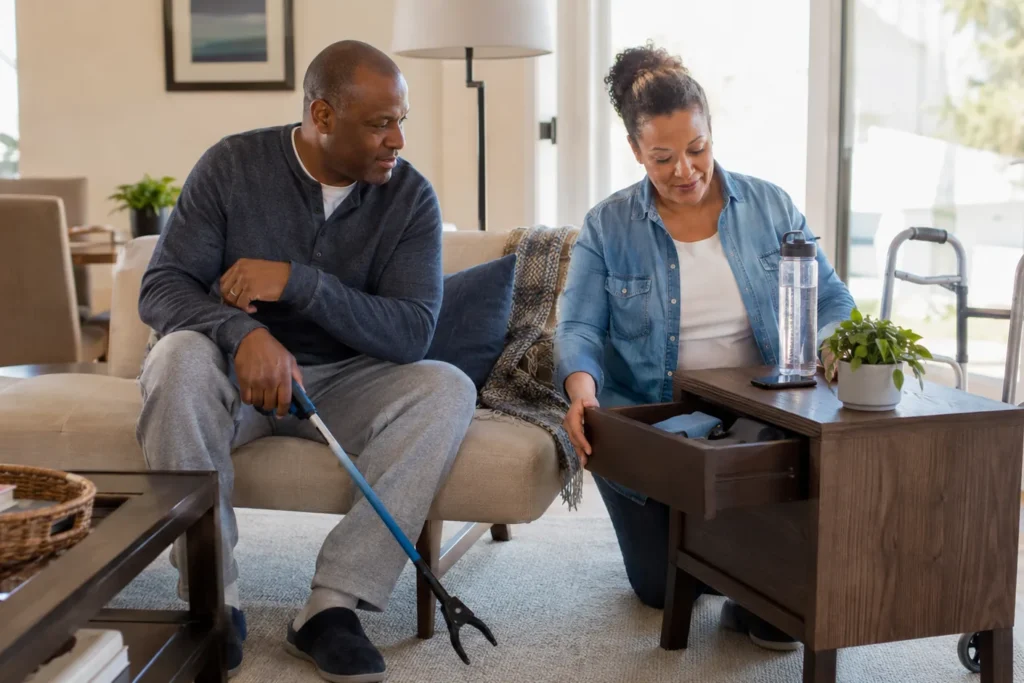

Preparing your home before surgery is not about buying every recovery product you can find. Most of the useful work is simpler: clear the routes you will use, move everyday items within reach, check the lighting, take a few measurements, and ask your care team about anything that depends on your procedure.
Take this guide around the house with a tape measure and a notepad. You do not need to finish everything in one session.
Who this checklist is for
The medical sources behind this guide focus mainly on hip and knee joint replacement. They include patient guidance from MedlinePlus, OrthoInfo, and Kaiser Permanente Washington. If you are preparing for shoulder, spine, foot, ankle, ACL, hand, or another procedure, use this as a list of questions rather than a procedure-specific plan.
Your surgeon, therapist, and pre-operative instructions should decide which equipment you need, what movements apply to you, and whether your setup needs to change.
Not medical advice. This guide covers home organization and shopping preparation. It does not provide treatment, exercise, rehabilitation, medication, movement, or weight-bearing instructions. For advice about your home and individual needs, ask your care team or an occupational therapist.
Start with three jobs
Ask first. Take your questions to the pre-operative appointment before making structural changes or buying equipment.
Measure second. Record the doorways, steps, bed, chairs, and route to the bathroom. These numbers help your care team understand the home you will return to.
Clear, move, and light. Remove trip hazards, make frequently used items easier to reach, and improve lighting along the routes you expect to use.
Equipment comes after those conversations. A checklist can help you prepare, but it cannot certify that a home is safe or ready.
Questions for your care team
MedlinePlus suggests asking questions such as:
- How can I make my home safer?
- Do I need to rearrange my home?
- What supplies will I need when I get home?
- How much help will I need?
- How will I manage the bathroom and shower?
- Will I need crutches, a cane, or a walker?
- Are stairs likely to affect the discharge plan?
Also ask whether the walking aid or other equipment will be supplied, whether an occupational-therapy assessment is part of your care, and whether your surgeon has given you movement restrictions that affect the setup.
Write the answers down. It is easy to forget details when several appointments and preparations are happening at once.
Take five useful measurements
There is no universal ideal width, height, or distance in the sources reviewed for this article. These measurements are not pass-or-fail tests. They are practical information to share with the people helping you.
1. Doorway clear widths
Measure the actual opening with the door in the position it will be used. Start with the bathroom and bedroom, then measure the narrowest points along the route and at the entrance.
If your care team expects you to use a walker, cane, or crutches, ask whether the expected aid will fit through those openings and turns.
2. Bed height
Measure from the floor to the top of the mattress. Sit on the edge as you normally would and note whether your feet rest flat on the floor. Do not adjust the bed to a number found online. Take the measurement to your care team.
3. Chair heights
Measure the chairs you actually use, from the floor to the top of the seat cushion. Note whether each chair has arms, a firm seat, and a firm back. Your care team can tell you whether any chair should be changed or avoided.
4. Steps and handrails
Count the steps at every possible entrance and on any route between the sleeping area and bathroom. Note where handrails are present, which side they are on, and whether they feel loose.
Choose nothing structural based on this checklist alone. A care team should confirm what is needed, and a qualified installer should assess any rail, grab bar, or ramp.
5. Sleeping area to toilet
Record whether they are on the same level and how many doors, turns, or stairs sit between them. If they are on different levels, ask whether a temporary sleeping area or bedside commode should be considered.
Keep all five measurements on one page so you can take them to an appointment.
Room-by-room preparation
Use the same pattern in every space: clear, move, light, measure, and confirm.
Entrance and approach
Clear the path from the car to the door. Move hoses, planters, tools, bins, and anything else that narrows the route. Check outside lighting and note thresholds or uneven areas.
Record the number of steps at each entrance and whether the handrail is secure. Ask your care team which entrance makes the most sense with the aid they expect you to use.
Hallways and routes
Walk the routes from the entrance to the chair, bed to bathroom, and bed to kitchen. Remove loose rugs, cords, clutter, and anything stored on the floor or stairs. Rearrange furniture if it creates a narrow turn.
Add a night light along the bedroom-to-bathroom route and make sure switches are easy to reach. Measure the narrowest point, not the average width of the hallway.
Sleeping area
Clear the floor beside the bed and the route to the door. Put a lamp, phone, charger, glasses, tissues, and water within comfortable reach. Check that lighting can be controlled from the bed.
If the bedroom is upstairs, ask whether a temporary sleeping space on another level is appropriate. If the hospital mentioned a special bed, confirm whether it is actually needed and who arranges it.
Bathroom
Bathrooms usually need the most careful planning because they combine tight spaces, water, and fixed fixtures.
Remove loose rugs and keep the floor clear. Put soap and shampoo somewhere reachable. Check the lighting before entering the room, and measure the doorway and toilet height.
Ask your care team whether you need any of the categories named in the source material:
- Raised toilet seat or toilet-seat riser
- Shower chair, bath chair, or tub-transfer bench
- Grab bars or safety bars
- Non-slip surfaces
- Hand-held shower
- Long-handled sponge
- Bedside or three-in-one commode
These products solve different problems and fit different bathrooms. Do not assume one can substitute for another. Grab-bar position and installation require individual advice and a qualified installer.
Kitchen
Clear some counter space so there is always somewhere to put an item down. Move the things you use most often between waist and shoulder height when possible. Put frequently used food, dishes, and supplies within easy reach.
Prepare simple meals or arrange help with food and groceries. If you expect to use a walking aid, ask what kind of bag, basket, or caddy can be attached safely before buying one.
Living and seating areas
Clear the route to the chair you expect to use and leave space around it. The cited guidance commonly describes stable seating with a firm cushion, firm back, and two arms. Measure your chair and ask whether it is suitable for your instructions.
Place a lamp, phone, charger, and other essentials within reach. If the route across the room is long, ask whether a rest point would help.
Laundry, storage, clothing, and shoes
Move the clothing and household supplies you will need away from very high or low shelves. Put clothes and shoes where they can be reached without searching through floor-level drawers.
If laundry involves stairs, carrying, or a basement, arrange for someone else to handle it. Your care team can advise about clothing around a dressing or brace.
Equipment: ask before you buy
The sources mention categories, not a universal shopping list. What you need depends on your procedure, your home, and what your care pathway already supplies.
| Category | What to check | Who should confirm it |
|---|---|---|
| Walker, cane, or crutches | Doorways, turns, stairs, and planned routes | Surgeon or therapist |
| Raised toilet seat | Toilet height and surrounding clearance | Care team |
| Shower chair or transfer bench | Bathroom doorway and shower or tub dimensions | Care team |
| Grab bars and handrails | Location and wall construction | Care team and qualified installer |
| Long-handled aids | What tasks your instructions say to avoid or adapt | Occupational therapist or care team |
| Bedside commode | Distance and level between bed and toilet | Care team |
| Walker bag, basket, or caddy | Compatibility with the exact aid | Supplier or care team |
For each item your team recommends, ask whether it is already available, supplied through the care pathway, borrowed, rented, or something you need to buy. Measure anything you already own before assuming it will not work.
Nothing in this list confirms FSA or HSA eligibility. That requires a separate check for the exact product and your plan.
Arrange the people as carefully as the rooms
Write down who will help and when. Avoid relying on a general promise that “someone will be around.”
Cover meals, groceries, laundry, cleaning, transport, children, and pets. Decide where deliveries will be left and who will bring them inside. Keep the phone and care-team contact information easy to find.
Put the hospital’s pre-operative instructions in one fixed place. Those instructions outrank this checklist.
A sensible order of work
The sources do not establish one universal timetable, so let your appointments and pre-operative packet set the dates. The order can still save time and money:
- Ask your care team what applies to your procedure.
- Measure the home and take the numbers back to them.
- Clear floors, cords, rugs, and routes.
- Move everyday items within reach and improve lighting.
- Arrange people, meals, transport, children, and pets.
- Obtain only the equipment your care team confirms.
- Do one final walk through the planned routes before surgery.
Raise structural work early. Handrails, grab bars, ramps, and fitted equipment may require more time and professional help.
Printable checklist
Before making changes
- Questions written for the care team
- Expected walking aid confirmed
- Supplied or arranged equipment identified
- Occupational-therapy or home assessment discussed
- Procedure-specific restrictions recorded
- Pre-operative instructions stored somewhere findable
Measurements
- Doorway clear widths
- Bed height
- Chair heights and armrests
- Steps and handrails at each entrance
- Sleeping-area-to-toilet route and level
- Measurements taken to the appointment
Around the home
- Entrance route clear and lit
- Rugs, cords, clutter, and floor hazards removed
- Bedroom-to-bathroom route lit
- Bedside essentials within reach
- Bathroom doorway and fixtures measured
- Kitchen essentials moved within reach
- Stable seating area prepared
- Laundry and carrying help arranged
- Children and pets assigned to a named helper
- Transport and meal plans confirmed
Equipment
- Each item confirmed by the care team
- Existing items measured
- Supplied, borrowed, rented, or purchased status recorded
- Fitting or installation responsibility assigned
- Manuals kept with the equipment
Completing the checklist records your preparation. It does not determine whether the home or equipment is medically appropriate for you.
Frequently asked questions
Which room should I sleep in?
The sources commonly raise a sleeping area on the same level as a bathroom when possible, but your care team should confirm what works for your procedure and home.
Will a walker fit through my bathroom door?
Measure the clear doorway and any tight turns, then take those numbers to your therapist or supplier. Do not choose a different aid on your own because a doorway is narrow.
How high should the bed or chair be?
There is no universal number in this guide. Measure what you have and ask your care team what applies to you.
Do I need grab bars?
Ask your care team. If they recommend them, a qualified installer should assess placement and whether the wall can support them.
Is a shower chair the same as a transfer bench?
No. They fit different bathroom layouts and needs. Measure the space and let your care team identify the appropriate category.
How early should I start?
Start with questions and measurements as soon as your pre-operative team is ready to discuss discharge needs. Let their schedule, not a generic online countdown, set your deadlines.
Methodology
Research-based, from named public patient-education sources: two MedlinePlus patient-instruction pages (U.S. National Library of Medicine), four OrthoInfo pages (American Academy of Orthopaedic Surgeons), and one Kaiser Permanente Washington handout. Each was opened and read on the date below, and source-derived medical, equipment and home-modification claims are attributed in the sentence that carries them.
Byline: Kade Lato. Kade Lato is the founder’s editorial pen name. No clinical, tax, or benefits-administration credential is claimed.
PainRecoveryPro has not visited or assessed any home, performed or commissioned an occupational-therapy assessment, or hands-on tested, used or purchased any product, and holds no clinical or occupational-therapy credential. Nothing here rests on personal experience, and nothing has been reviewed by a clinician or therapist.
Structure, wording and organization are this article’s own, a non-clinical synthesis rather than source instruction: the walk order, the question framing, the delivery and car logistics, the per-room shape, the “who decides” table, the four-outcome sourcing frame, the walk-order checklist, and the gathering of measurements the sources scatter. No source’s checklist is reproduced.
This article carries no affiliate links, tracking parameters or referral codes, and names no brand, model, price or merchant. See also Editorial Standards and the Medical Disclaimer.
Sources and dates
Every source below was opened and read on September 1, 2026.
| Source | Issuer | Role here |
|---|---|---|
| MedlinePlus patient instructions on getting your home ready for knee or hip surgery | MedlinePlus, U.S. National Library of Medicine (NIH) | The room-by-room backbone, plus the deference sentence quoted above |
| MedlinePlus patient instructions on what to ask your doctor before a hip or knee replacement | MedlinePlus, U.S. National Library of Medicine (NIH) | The pre-operative question list, so the questions here are published, not invented |
| Preparing for Joint Replacement Surgery | OrthoInfo, American Academy of Orthopaedic Surgeons | Home preparation: testing a borrowed aid, rugs and cords, long-handled aids, reach, cooking ahead. Also the instruction-following sentence quoted above |
| How To Use Crutches, Canes, and Walkers, “Make Your Home Safer” section only | OrthoInfo, American Academy of Orthopaedic Surgeons | General walking-aid guidance, not procedure-specific. Home-safety section only: path width, stairs and treads, the bedroom-to-bathroom nightlight, bathroom items, carrying |
| Total Knee Replacement, “Home Planning” section only | OrthoInfo, American Academy of Orthopaedic Surgeons | Procedure-specific corroboration for the scope statement; a second listing of the same categories |
| Total Hip Replacement, “Home Planning” section only | OrthoInfo, American Academy of Orthopaedic Surgeons | The same list for the hip, adding a long-handled sponge and shower hose, a dressing stick, sock aid, shoehorn, reacher and firm pillows |
| Total joint replacement home safety checklist | Kaiser Permanente Washington | One health system’s regional handout, not a national standard. Corroboration and structure throughout, plus the occupational-therapist route quoted above |
Limitations recorded on September 1, 2026
- Six of the seven documents are specific to hip or knee joint replacement; the seventh, OrthoInfo’s page on using crutches, canes and walkers, is general walking-aid guidance, and only its home-safety section is used. The preparation detail here is therefore primarily hip-and-knee joint-replacement evidence. None of the seven addresses shoulder, spine, foot and ankle, ACL or hand procedures, nothing is generalized to those, and readers with another procedure are routed to their own instructions at the top.
- Only the two MedlinePlus pages carry review dates: 11/7/2024 for the home-preparation page, 6/4/2025 for the question list, both updated by C. Benjamin Ma, MD, and also reviewed by David C. Dugdale, MD, Brenda Conaway and the A.D.A.M. editorial team. The four OrthoInfo pages and the Kaiser checklist displayed no review or update date; the OrthoInfo pages name contributors and peer reviewers instead, and the Kaiser handout carried no document number.
- The Kaiser document is one health system’s handout, used for corroboration and structure and attributed as such throughout. Its footnote marks its equipment entries as “Adaptive equipment options” rather than requirements.
- One figure and one rationale are deliberately not carried. The OrthoInfo knee page states a chair seat height in inches, which appears nowhere here because it would read as a target and seat height is clinical. The hip page phrases several entries around hip movement; the category and the room are used, the rationale is not, because precautions belong to the reader’s surgeon.
- The crutches, canes and walkers page also contains technique instruction. None is reproduced or paraphrased; only its home-modification portion is used, because how to use an aid belongs to the reader’s therapist.
- Some source items are activity or timing instructions and are not used: a limit on stair use, a caregiver arrangement stated as a period after surgery, cooking ahead stated as a narrow number of weeks, and a non-numeric instruction to prepare well ahead of the date. Those concern single tasks; the sources do not establish one universal schedule for the whole process, so no lead time is published and the calendar is left to the reader’s care team and pre-operative packet. No activity instruction and no recovery timeline appears here.
- No doorway width, seat height, bed height, step height or distance is published here as a threshold determining suitability, and no source read for this article publishes one in that form. The measurements gathered above are this article’s own arrangement of what the sources raise: numbers to hand to a care team or equipment provider, not targets. The PainRecoveryPro articles referenced above are unpublished drafts, with no live link to any.
Last reviewed: September 1, 2026.