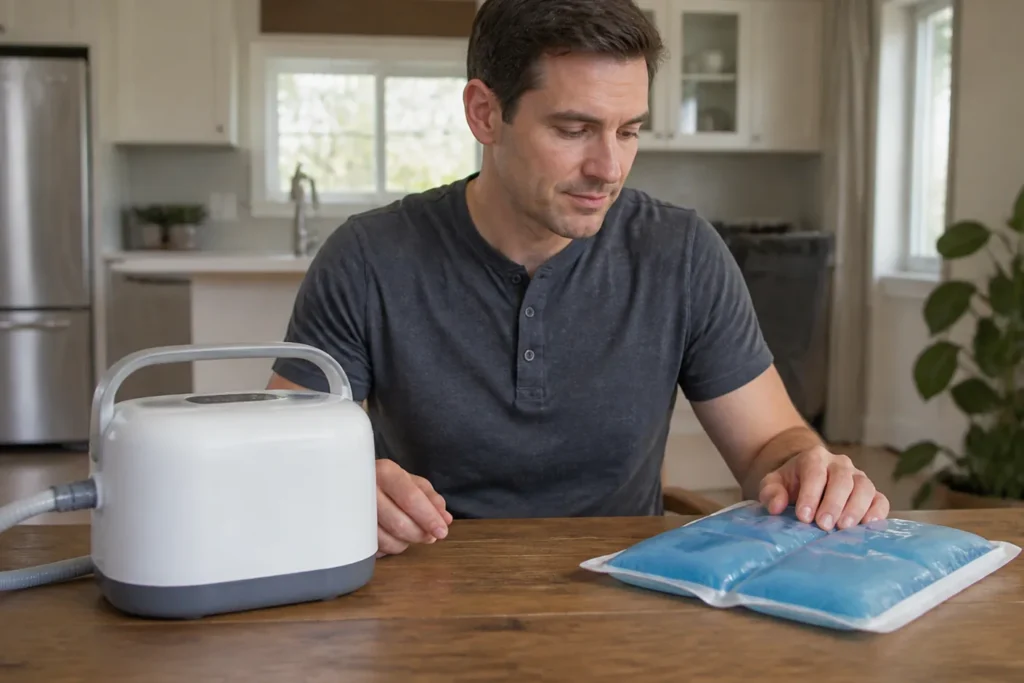
If your care team has recommended cold therapy, you may be choosing between a powered machine that circulates chilled water through a pad and reusable packs kept in the freezer.
Neither option is automatically better. The useful question is which one fits the instructions you were given, the setup you can manage, and the practical realities of your home.
This comparison covers cost factors, setup, maintenance, portability, and the safety instructions published for the products reviewed. It does not compare pain relief or recovery outcomes because the sources used here do not support that conclusion.
This is not medical advice. Ask your clinician whether cold therapy is appropriate for you and how it should be used. Follow your own discharge instructions and the manual supplied with your exact product.
The short comparison
| Powered cold-therapy machine | Reusable cold pack | |
|---|---|---|
| How it works | Pumps chilled water from a reservoir through a connected pad | Holds chilled gel or another cold material against the area |
| Preparation | Fill with ice and water, connect the pad, and plug in, following the exact manual | Chill in a freezer for the time stated by the manufacturer |
| Ongoing work | Refill, drain, clean, dry, and manage tubing and power | Re-freeze, clean the cover, and store as directed |
| Cost factors | Machine, pads or accessories, ice, water, electricity, possible rental or replacement parts | Packs, freezer space, and eventual replacement |
| Portability | Requires power, a stable place for the reservoir, and somewhere to drain it | Easier to carry, but needs a freezer or suitable cooler |
| Instructions | Device-specific manuals often contain detailed barrier and skin-check requirements | Pack instructions contain their own warnings and may differ from machine guidance |
These are format differences, not a recommendation. The exact product and your care plan still control the decision.
What each option is
The FDA describes water-circulating devices as units that move chilled or warmed water through tubing to a wrap placed over the treatment area. Some models provide cold only, while others may also provide heat or compression.
The Breg Polar Care Cube and Vive Essential machine reviewed for this article are filled manually with ice and water. Their instructions differ, including the order in which ice and water are added. That is an important reminder that apparently similar machines are not interchangeable.
A reusable pack has no pump, reservoir, or electrical connection. It is chilled in a freezer and warms while being used. The Elasto-Gel instructions reviewed here cover several reusable wraps and sleeves and include their own storage, cleaning, and safety information.
The FDA notes that water-circulating devices can remain colder for longer periods, which makes correct use especially important. That does not establish that a machine works better or is safer than a pack.
Begin with the exact manual
Before using either format, find the instructions for your exact model. Do not rely on a general video, another brand’s manual, or the way a similar product was used previously.
The documents reviewed for this comparison serve different purposes:
- The FDA page gives general consumer information about water-circulating devices.
- Breg’s instructions apply to specific Breg devices and include directions for the practitioner supplying them.
- Vive’s owner’s manual applies to its consumer machine.
- Southwest Technologies’ directions apply to named Elasto-Gel wraps and sleeves.
Each document governs only the product it names.
How you obtain the equipment
The route depends on the model.
Breg’s Polar Care instructions state that federal law restricts that device to sale by or on the order of a medical professional. Its documentation also describes a discharge process in which a licensed professional screens and instructs the patient.
The Vive manual reviewed for this article does not contain that federal-sale statement. That is a fact about the document, not a legal conclusion about the product category.
Before deciding, ask:
- Is the equipment being supplied through my care pathway?
- Is it being purchased or rented?
- What is included with it?
- Who provides the pad or wrap for the relevant body area?
- Who should I contact about fitting, setup, returns, or a malfunction?
No rental market or pricing was surveyed for this article. Confirm availability and terms with your care team or supplier.
Setup and daily work
Powered machine
A machine generally needs a stable location, ice, water, power, tubing, and a pad. The order matters.
Breg’s instructions add water first and then ice. Vive’s manual adds ice first and then water. Their cleaning instructions also differ: Breg mentions warm water and mild detergent for certain maintenance, while Vive says to run water only through its unit and not soaps, salts, or solvents.
Follow the manual that came with your machine. Do not merge steps from two products.
Expect recurring work such as:
- Making or buying ice
- Refilling the reservoir
- Keeping tubing out of walkways
- Draining the pad and machine
- Cleaning and drying the equipment
- Checking that the correct person understands the instructions
Neither machine document reviewed here provides a universal refill schedule. Your care instructions and actual device determine when attention is needed.
Reusable pack
A reusable pack is simpler mechanically but still needs preparation. The Elasto-Gel directions require freezer storage in a sealed bag and a stated chilling period before first use. The outer cover is hand-washed in cold water with mild soap, while the inner cover is wiped and allowed to dry fully.
The pack must be re-chilled between uses. None of the documents reviewed here provides a universal swap schedule.
Where the cost comes from
Prices change and differ by supplier, so this comparison focuses on the parts of ownership that create cost.
For a powered unit, consider:
- Purchase or rental charge
- Body-area-specific pad
- Accessories or replacement parts
- Ice, water, and electricity
- Delivery, collection, or return terms
- Time spent filling, draining, and cleaning
Breg lists separately available pads and accessories for its system, including tubing and power components. Vive lists the bucket, universal pad, straps, and adapter included with its unit. Check the package for the exact model you are considering.
For reusable packs, consider:
- Number and size of packs needed under your instructions
- Freezer space
- Cleaning and storage
- Replacement if the pack or cover is damaged
Ask who will handle the recurring work. That practical question can matter as much as the purchase price.
Portability and space
A powered machine needs an outlet, a stable surface, room for its tubing, and somewhere to empty the water. A filled reservoir can also be much heavier than the empty unit. Breg publishes separate empty and filled weights for some models, so check the specification for yours before planning to move it.
Keep electrical connections dry and place cords and tubing where they will not become trip or entanglement hazards. Use the warnings supplied with your machine.
A reusable pack is easier to move around the home, but it depends on access to a freezer. Elasto-Gel’s instructions describe transporting its products in a sealed bag inside a cooler with reusable cooler packs rather than loose ice.
For either option, think through where it will be stored, prepared, used, and cleaned before it arrives.
Safety differences that matter
Cold can injure skin and tissue when equipment is used incorrectly. The FDA reports receiving complaints involving pain and injuries from water-circulating devices, including serious cold-related injuries. Its page does not provide an injury rate, so those reports should not be read as a probability.
Barrier between the product and skin
The FDA and the machine documents reviewed here discuss a barrier or insulation between the pad and skin. The exact material and placement depend on the device and the practitioner’s instructions.
The Elasto-Gel directions reviewed here do not state the same barrier requirement. That does not mean another pack can be placed directly on skin. Follow the instructions supplied with your exact pack.
Skin checks and timing
Breg assigns the skin-check interval, frequency, duration, and breaks to the prescribing practitioner. Vive also instructs users to monitor the skin. The FDA advises frequent checks and keeping the area dry.
No universal number is given here. Use the schedule written for you and your device.
When to stop and contact someone
The FDA advises stopping and contacting a health care provider for changes such as numbness, unexpected or worsening pain, burning, itching, blistering, welts, increased swelling, redness, discoloration, or another change in the skin’s appearance. Breg and Vive publish their own product-specific warnings.
Read the list in your manual before the first use, and keep the care team’s contact route nearby.
Overnight use
Do not infer permission from the fact that a machine can run for a long time. Breg’s protocol form leaves awake or asleep use to the licensed professional completing it, and its instructions say to unplug the unit after use and not leave it unattended. Ask the person who set your protocol whether overnight use is part of it.
Questions to ask before choosing
- Which format does my care team want me to use?
- Is a specific model being supplied or prescribed?
- What pad or pack fits the body area involved?
- What barrier should be used?
- How long, how often, and at what skin-check interval?
- Who will fill, drain, clean, or re-freeze it?
- Can the equipment be used overnight under my instructions?
- What should make me stop and call?
- Who handles a malfunction or missing part?
- What is the full purchase or rental cost?
Frequently asked questions
Is a cold-therapy machine better than an ice pack?
The documents reviewed here do not establish that. They support a comparison of mechanics, setup, cost factors, and safety instructions, not recovery outcomes.
Do I need a prescription?
It depends on the model and how it is supplied. Breg’s document contains a federal-sale restriction for the named device. The Vive manual reviewed here does not. Check the exact product and ask the supplier or care team.
How often do I refill a machine or swap a pack?
No universal schedule appears in the reviewed documents. Follow your device manual and the instructions given by your clinician.
Does the pad or pack go directly on skin?
Follow the exact product instructions. The FDA and reviewed machine documents discuss a barrier, while the reviewed Elasto-Gel directions do not state the same requirement. Do not transfer one product’s instructions to another.
Can I sleep while using it?
Only if the clinician responsible for your protocol and your exact product instructions permit it. Do not assume that longer cooling capacity means unattended use is acceptable.
Which option is easier?
That depends on your home and help. A machine requires filling, power, tubing, draining, and cleaning. A pack requires freezer access, re-chilling, and cleaning. Compare those tasks against what you and your caregiver can realistically manage.
Methodology
This article is research-based. It was compiled from five documents, issued by four bodies and read on the date below: one U.S. Food and Drug Administration consumer update, and four manufacturer documents, being Breg’s Polar Care instructions for use and its Cube product page, Vive Health’s Essential Ice Therapy Machine owner’s manual, and Southwest Technologies’ Elasto-Gel directions for use. Every safety statement, requirement and quotation is attributed in the sentence that carries it, to the regulator or to the named manufacturer and the product its document covers. No vendor comparison, rental-company blog, affiliate round-up or clinical-effectiveness literature was used.
Byline: Kade Lato. Kade Lato is the founder’s editorial pen name. No clinical, tax, or benefits-administration credential is claimed.
PainRecoveryPro has not used, filled, run, timed, measured, drained, cleaned or tested any cold-therapy unit or reusable pack, has handled none of the products named, and holds no clinical, nursing or therapy credential. Nothing here rests on personal experience, and no clinician has reviewed it. Manufacturer material is commercial. It is cited as instruction and specification, never as endorsement, and manufacturer claims about what a product achieves for a patient are deliberately not repeated.
The structure is this article’s own non-clinical synthesis rather than any source’s: the document-type ladder, the comparison table, the cost-driver breakdown, the setup contrast between two manuals, the portability prerequisites, the source-by-source treatment of the barrier requirement, and the questions for the care team.
Left undecided here, deliberately. Which format is better, more effective or more appropriate for you. Whether a machine is worth it, or whether packs are enough. Whether either reduces pain or swelling more, or does anything at all for your recovery: no clinical-superiority claim is made here in either direction, and none is implied. Whether you should be using cold at all. How long, how often, how cold, how long a break, or for how many days. Whether any condition of yours makes this unsuitable. Which brand or model to buy or ask for. You will find no ranking, no shortlist, no “best” label and no product pick; no price and no claim about what anything costs; and no merchant link, affiliate link, referral code or tracking parameter. Nothing named above earns anything. The three manufacturers appear only as the authors of documents being cited, and naming a document’s author is not a recommendation of its product.
Companion PainRecoveryPro articles cover preparing a home before surgery, the first week home afterwards, and checking whether an exact product is eligible for a health account. All are unpublished drafts, so there are no links to give.
See also Editorial Standards and the Medical Disclaimer.
Sources and dates
Every source below was opened and read on September 1, 2026.
| Source | Issuer | Role here |
|---|---|---|
| Cold Facts to Help Avoid Injury from Water-Circulating Hot/Cold Therapy Devices | U.S. Food and Drug Administration | The device description; the reported harms; the format difference quoted once above; the barrier, fit, skin-check and stop-and-contact guidance; the MedWatch route. Footer date 09/09/2020 |
| Polar Care Glacier / Kodiak / Cube Instructions for Use, AW-1.01678 Rev C 01/24 (PDF) | Breg, Inc. (manufacturer) | One device’s own requirements: the federal sale restriction, the insulation-barrier requirement, the prescribed skin-inspection instruction, the discontinue list, the electrical and setup instructions, and the practitioner-facing discharge protocol and protocol form. Much of it addresses the prescriber rather than the patient |
| Polar Care Cube product page | Breg, Inc. (manufacturer) | Product identity, the repeated sale restriction, and the parts the cost section names. No review or update date is displayed |
| Essential Ice Therapy Machine owner’s manual, model RHB3026BLK, document 270724 (PDF) | Vive Health (brand owner; the manual names a distributor in Naples, FL) | The second unit’s own document: setup order, power and connection cautions, cleaning and storage instructions, the barrier warning, skin monitoring, and the discontinue-and-seek-attention list. It contains no federal sale restriction, a fact about the document rather than a regulatory conclusion. An owner’s manual rather than a regulated instructions-for-use sheet; no revision date beyond the document code |
| Directions for Use: Elasto-Gel hot/cold therapy wraps, HCTBLU-DFU-VER1.1 10-20 (PDF) | Southwest Technologies, Inc. (manufacturer) | The reusable-pack side: freezer preparation and storage, cooler transport, cleaning, and the cold-use cautions above. Marked “Reviewed and updated 01/2019”. Covers named wraps and sleeves |
| The instructions that came with your own device or pack | The manufacturer of that product | Named as the document that governs you. It is the one every section above sends you back to, and the one nobody else can read for you |
Limitations recorded on September 1, 2026
- The FDA source is a consumer update, not a standard or a guidance document, and its footer date is 09/09/2020. It describes reports the agency received and quantifies nothing. Its remark that clinicians commonly prescribe such devices is not a statement that every one is prescription-only, and it is not used as one.
- Four of the five documents are manufacturer material, and manufacturer material is commercial. It is the right class of source for what a product requires of its user, and the wrong class for whether a product is any good. Product-benefit language on those documents is deliberately not repeated.
- Every model-specific statement belongs to the named model only. Two powered units and one reusable-wrap family are documented, out of markets that were not surveyed. If your product is not named above, take only the procedure: find your own document and read it. The heating instructions in the Elasto-Gel sheet are out of scope.
- Nothing here is a legal conclusion about how any device may be sold. One document carries a federal sale restriction; two carry none. An absence in a document establishes what that document does not say, and no more. It establishes no product’s regulatory status, and none is inferred above. No source read here evidences any rental market, its terms or its availability.
- The Elasto-Gel directions state no barrier requirement for cold use, so no barrier instruction is attributed to that document. That is a fact about the document, not a statement that packs need no barrier.
- No application-duration number, no application-frequency number, no treatment temperature, no break interval and no numerical skin-check interval appears anywhere above, not even where a source prints one. Breg’s instructions for use publish a typical skin-check example for their own device while requiring the practitioner to set the patient’s interval, and that number is deliberately left out, because a device-specific example lifted out of its document reads as general guidance. The one temperature figure above, −20°F (−30°C), is not a treatment temperature. It is the manufacturer’s statement about how its gel behaves in a freezer. The remaining numbers, being weights, a tube length, voltages, document codes and dates, are equipment specifications and citation details.
- No price, rental quote or availability observation was made or published. No clinical-effectiveness literature was read, because no effectiveness claim is made in either direction. The silence on which format works better is deliberate.
- The PainRecoveryPro companion articles referenced above are unpublished drafts, so there are no live links to them.
Last reviewed: September 1, 2026.